Showing posts with label Airplane ownership. Show all posts

Tuesday, April 7, 2026

Back to the Bricks | Part 1, Modernization

Homeward Bound

During the fall of 2025, I began a dialog with Jess, a Professor of Chemistry at the University of Michigan-Flint, my alma mater set at the intersection of the Flint River and the red brick thoroughfare of Saginaw Street. She extended an invitation to visit campus and speak with students about careers in chemistry. It would mark my first return visit since 2015 when I participated in a curriculum advisory committee ("Nature's Power Washer"). Later that fall, I met with faculty again when I returned with Kristy to experience our first University of Michigan football game in The Big House ("Somewhere Over the Rainbow"). For my talk with students, Jess and I agreed on the second week of April and shelved our discussion until 2026.

Though grudgingly, winter finally deferred to spring and I expected good enough weather to fly myself to Flint for the visit. However, it was clear by early 2026 that I would not make that flight to Michigan in the same manner as over the last twenty years and that there were two barriers, surmountable ones, standing in the way.

The Future Is Bright and It Comes with a Touch Screen

I trained for my instrument rating in Warrior 481 behind a trusty Garmin GNS 430W navigator, a capable piece of equipment that I came to understand so well that I taught my instrument examiner something new about its operation during my test. The 430 displays its 1990s roots overtly with a minimally colored moving map display featuring Nintendo Game Boy quality graphics. Still, for a 1970s airplane, installation of the 430W was a massive modernization. At the time I installed it, my friend Garrett flew freight for an outfit based at Oakland County International Airport. “I would give anything for the capability of a 430,” he exclaimed at the time, then regaled me with tales of flying dodgy NDB approaches into other parts of the world.

However, as time went by, the noble 430W accumulated disadvantages versus current technology. Those included diminishing trade-in value, increasing scarcity of components for repairs, and simply being more cumbersome to use than modern navigators. Specifically, 430W users risk repetitive stress injuries from knob twisting during IFR reroutes. (Kidding. Sort of.) For 2026, I decided to futureproof my IFR flying while taking advantage of the 430W's residual monetary value and traded it in for a Garmin GTN 650 Xi. Like the 430W, the 650 integrates radio communications, a VHF navigation receiver, and a moving map GPS into a single box, but does all of this behind a colorful high resolution display doubling as a touch screen interface with a virtual QWERTY keyboard available for data entry.

DateAircraftRoute of FlightTime (hrs)Total (hrs)
15 Mar 2026N21481SDC (Sodus, NY) - GVQ (Batavia, NY)0.63116.0

I ferried Warrior 481 to the Genesee County Airport (GVQ) on March 15, hitching a ride home with Gilead in Archer Eight Five X-Ray. Unexpected icing between Genesee County and Rochester made the return flight memorable, but with a precautionary diversion to Rochester, all was well.

Thus, making the flight to Flint became a question of whether the avionics work would be completed by my April 8 departure date. Fortunately, the work was portentously completed on April 1 (ha ha!) and I retrieved the airplane on Saturday, April 4 with huge thanks to Kristy for ground support.

1970s Tech Comes to the Rescue

Date Aircraft Route of Flight Time (hrs) Total (hrs)
04 Apr 2026 N21481 GVQ (Batavia, NY) - SDC (Sodus, NY) - ROC (Rochester, NY) - SDC 2.0 3118.0

As a check of 650 functionality immediately after startup, I tuned the field AWOS (automated weather observation station) and heard a strong, clear broadcast of current weather conditions. Satisfied, I completed my departure preparations and launched skyward.

Spoiler alert: the GTN 650 Xi as installed and operated during the round trip to Flint, MI. Photo from April 11, 2026.

A problem quickly became apparent, however. Every effort to raise Rochester Approach for passage through their Charlie airspace failed. I resorted to "old reliable", the 1970s era King KX-170B radio still in the panel, to achieve two way communication with Rochester. When the new tech fails, it's good to know that stuff from the 70s literally keeps on truckin'.

On approach to Sodus, the 650 failed to pull in radio calls from pattern traffic a mere five miles away and conversely, none of them could hear my futile pleas for radio checks. It was the KX-170B to the rescue once more. I managed one successful radio check with the 650, but it was while chief instructor Mike was launching 300 feet away from where I taxied. Even receipt of the on-field AWOS broadcast was weak and scratchy. Something was definitely amiss with the 650.

Nevertheless, I took the Warrior aloft again that day and successfully tracked VORs, flew the ILS-22 at Rochester and two RNAV-28 approaches at Sodus, and executed a perfect hold in lieu of procedure turn (or HILPT) maneuver. The 650 drove HAL, my Garmin autopilot, beautifully. But all voice communications were forced to rely on 50 year old radio tech. That afternoon, I determined that the 650 worked flawlessly in all regards except that transmission and receipt of radio communications were both inexplicably weak. I even crawled behind the rear bulkhead and into Warrior 481's empennage to verify that the communications antenna was actually connected to something. It was.

Buyer's Remorse

I debated for years about making this upgrade and receiving the airplane with a brand new but nonfunctional radio created a deflating sense of buyer's remorse. This was especially true because I had just given up a reliable and fully functional navigator. After thinking on it, I decided that I would fly the trip to Flint with a single functional radio (the really old one), but I was not happy about it. Availability of a handheld radio to monitor a second frequency did little to quell the sour feeling in my stomach about the money I had just spent.

Date Aircraft Route of Flight Time (hrs) Total (hrs)
06 Apr 2026 N21481 SDC (Sodus, NY) -GVQ (Batavia, NY) - SDC 1.3 3119.3

Fortunately, a small weather window opened on the morning of Monday, April 6. It was a gusty, unsettled atmosphere to swim through, but perfectly manageable. Despite spending mid morning to early afternoon at the shop, I still managed to get in a full day's worth of work by rising early and staying late. It was a long day.

In Batavia, the troubleshooting process took roughly twenty minutes to deliver a solution. In short, the installers connected the 650 to the wrong pointy bits on the Warrior's fuselage, swapping the communications and navigational antennas. Clearly, the Warrior was content to track a VOR through the comm antenna, but was not at all happy about broadcasting and receiving radio communications through the nav antenna. "Amateur hour," muttered the installer as he worked to make it right. This lack of attention to detail did little to assuage my buyer's remorse, but the first barrier was now removed. I had a fully operational airplane at my disposal for the flight to Flint.

Loss of Preferred Routing

The second barrier to the trip also derived from a decision I made in 2025. In the wake of various health concerns ("Warrior 481 Gets a Useful Load Increase"), I chose to let my third class FAA medical lapse and fly on BasicMed instead. While this significantly reduced the paperwork overhead involved in maintaining medical certification, it came with a downside relevant to my planned trip. Though I have flown directly from New York to Michigan via Canada dozens of times over the past 20 years, BasicMed is not recognized outside of US borders. I am now shut out of Canadian airspace.

Going the long way around.

Forgoing the direct route to Flint through Canada meant a more circuitous trek south of Lake Erie by way of Cleveland and Detroit that added 100 miles to the journey. It was also a route that passed through two Bravo airspaces surrounding the aforementioned cities. Past experience suggested that Cleveland is relatively easygoing about their airspace. However, transit through the Detroit Bravo has been a mixed bag over the years and often meant being vectored either around the Bravo entirely or directly over Detroit Metro (KDTW) on a path orthogonal to arrivals and departures. It was not lost on me that passing through the western fringe of the airspace (see graphic above) would put me downrange from Detroit's southwest oriented departure corridor with four parallel runways functionally aimed at me like "Boeing cannons". I was not sure how controllers at either facility would react to my passage through their airspace.

Back in My Day
(Stay off my lawn!)

In the old days, using established airways provided some assurance of acceptable routes through busy airspace. But with the shutdown of numerous ground-based VOR navaids in the Great Lakes region that physically anchored those Victor airway routes, the area has become an airway desert.

IFR low altitude en route chart (L-30) from 20 September 2012.

For example, the above photo is a paper IFR low altitude en route chart (L-30) from 20 September 2012 that shows all the airways (black lines crisscrossing the chart) and VORs (the circled features where those airways converge) between Cleveland (pale blue circle at the lower left) and Dunkirk, NY (upper right corner). For reference, the pale green outline is Lake Erie.

Current IFR low altitude en route chart L-30.

Today, the infrastructure looks very different. Above is a screen capture of the current low altitude IFR en route chart for the same region. The disappearance of airways and the VORs that anchor them is breathtaking. It's not just in the United States, either. Historically, several Victor airways were anchored to the Aylmer VOR in southern Ontario (visible in the 2012 L-30 chart). This station was also removed from service sometime during the last decade. (2018, if memory serves.) While I understand why these changes were made, it is hard not to feel a sense of loss in comparing today's charts against those printed when I was still an instrument student. That was a lot of cheese and someone moved virtually all of it.

IFR low altitude en route chart L-28 from 20 September 2012.

Likewise, the above chart (L-28) from 20 September 2012 shows Detroit (the largest blue area on the right) between Toledo, OH (the blue circle near the bottom of the chart) and Flint, MI (the blue circle at the top of the chart).

Current IFR low altitude en route chart L-28.

In this case, the Detroit area demonstrates the same extensive decommissioning of VORs and airways and also reflects the increase in diameter of the Detroit Bravo implemented in 2014. Interestingly, if one pans eastward looking for remaining Victor airways, their density increases significantly in eastern New York and extends out to the coastal hubs of Boston, NYC, and Philadelphia. But from Rochester west toward Michigan, the Great Lakes region is now functionally a GPS-direct zone for navigation.


Slightly Better than a Dartboard

So...how to choose a route?

In the absence of airway routing through these Bravos, I chose a route based on charted GPS waypoints between Sodus and Flint: GEE (an honest to goodness operational VOR south of Rochester), EDMNN (on the lakeshore north of Cleveland and deep within that Bravo), JERRI (to manage the shape of the lake near Sandusky), and HUUTZ (to line up with Flint). This route would keep my feet dry and avoid restricted areas (R-5502A&B). But it would also carry me through the Cleveland and Detroit airspaces. 

Will controllers allow me to fly that route? Let's file it and see what develops. At least I can talk with them now using whiz-bang 2020s tech instead of relying solely on a King radio fabricated 50 years ago.

Friday, December 5, 2025

Say Again? The Impossible Transmission

"You keep using that word. I do not think it means what you think it means."
- Inigo Montoya, The Princess Bride

The Binghamton Incident

Warrior 481's panel photographed 28 December 2022.

The first sign of trouble occurred while climbing away from Greater Binghamton / Edwin Link Field in 2023. With com2 (a vintage KX-170B) tuned to Binghamton Tower and Departure dialed in on com1 (Garmin GNS 430W), I swapped the transmitting radio from Tower to Departure with the audio panel when prompted by air traffic control.

"Cherokee Four Eight One, are you broadcasting on Departure and Tower simultaneously? I hear you on both," asked the radar controller after I checked in. By design, the airplane's audio panel only allows transmission on a single radio at a time and mine was set to the radio tuned for Departure. Nevertheless, I twisted the knob on com2 to an arbitrary frequency other than Binghamton Tower before responding. "Not intentionally." It was not standard phraseology, but there is no standard phraseology for an impossible act.

"Oh, that's better," responded Departure.

Weird. 

Unfortunately, I was distracted by other flight issues shortly after that exchange and completely forgot about the incident. 

Time went by.

In 2025, I was overflying Elmira / Corning Regional Airport and speaking with Approach on com1 while monitoring the emergency frequency (121.5 MHz, also known as Guard) on com2 per my standard practice.

"Cherokee Four Eight One, I am also hearing you on Guard every time you transmit." It was another comment suggesting transmission on two frequencies at once. It was just as impossible as before, but hearing this a second time focused my attention on the issue.

I wrote to PS Engineering, the manufacturer of my now fifteen year old audio panel, to ask if there was any known failure mode that might cause both radios to transmit at once. After all, the audio panel is the device that controls which radio transmits. My question was answered directly by the head of the company and his response definitely had a tone. "That is utterly impossible."

Yet I had two examples of air traffic control claiming exactly that. A quick test with a handheld  radio verified the ATC observations. Any transmission made on com1 was also broadcast on whatever frequency com2 was set to.

Inconceivable!

A Brisk 11 °F
   
Date Aircraft Route of Flight Time (hrs) Total (hrs)
05 Dec 2025 N21481 SDC (Sodus, NY) - GVQ (Batavia, NY) - DSV (Dansville, NY) - SDC 1.8 3094.1

It was my first winter flight of the 2025-2026 season; 11 °F under a clear blue sky with just enough snow piled against the bifold hangar door that it needed to be shoveled away. The first large snowbanks of the season were taking shape along taxiway edges.

Brisk!

Downtown Rochester, NY from 3,500 feet.

When presented with definitive proof of anomalous radio behavior, Jake proposed a gratis troubleshooting session with my radios and audio panel. I made the thirty minute flight from Sodus to the Genesee County Airport in crisply frigid air as the Warrior's heater endeavored to melt the sole of my right shoe. Unfettered sunlight poured down from above, reflecting from a landscape blanched by newly fallen powder.

I set up my computer in an airport conference room and worked while Jake examined the Warrior's avionics. He reappeared only thirty minutes later with a hangdog expression to explain that when he installed the autopilot in 2021, he miswired the audio panel such that clicking the push to talk button keyed both radios.

Panel photo taken 18 June 2021 showing the audio panel (top of center radio stack), com1 (GNS 430W directly below the audio panel), and com2 (KX-170B right of com1 under the "Warrior" placard).

I was shocked that I had flown the airplane over four years in that condition with only two comments from ATC. I was surprised that I did not constantly receive "you're on Guard, dude" commentary from other pilots every time I transmitted to Approach or Center on com1 while monitoring the emergency frequency on com2.

We would have caught the problem sooner had my com2 been a more modern radio with a "transmit" indicator that illuminates when the radio is broadcasting. My ancient KX-170B has no such amenity,  presenting an impassive face while blathering away on whatever frequency it is set to.

As always, Jake made it right before I left Batavia that day.

A Chance Encounter


With the impossible transmission made properly impossible again, I departed Batavia and flew to Dansville for a quick bite to eat, then navigated the valleys east of Dansville on a roundabout route back to Sodus.


Approaching Canandaigua Lake from the south.

I landed at Sodus behind a member flying the club's Bold Warrior. With a ramp covered in black ice, I struggled to coax the Warrior into the safety of the hangar, even while shod with YakTrax. When finished, I noticed the Bold Warrior taxiing from the fuel pump to a hangar and hurried over -- as much as possible without wiping out on the ice -- to help the pilot push that plane into its hangar.

Brendan and I had never met before, but I learned that he was an air traffic controller at Syracuse.

"Oh!" I said. "Are you the Syracuse controller who always asks what we're up to when we fly places with multiple airplanes?"

He laughed and explained that most of the ATC team in Syracuse knew our tail numbers and recognized that we frequently did group fly-outs. I used to suspect we had a reputation, now I am certain of it. When I told him my tail number, he said, "Oh, I have definitely talked to you before." I praised him and his colleagues for their continued excellent service during the recent government shutdown.

Next, he described where he flew that day and asked about where I went. I explained the double transmission issue that I went to Batavia to resolve, describing how surprised I was that it took four years to realize I had a problem. "That happens more often than you'd think," he responded. "I usually tell pilots when it's happening, but some other controllers don't."

It would seem that the impossible is more possible than I thought.

Tuesday, April 9, 2024

Honey, I Think We've Lost Our Spark

Expect the Unexpected

By design, $100 hamburger runs rarely involve much adventure beyond the expected aviating. Sometimes, additional adventure -- perhaps "excessive adventure" -- finds you anyway.

Keen(e) to Explore

Date Aircraft Route of Flight Time (hrs) Total (hrs)
09 Apr 2024N21481 SDC (Sodus, NY) - RME (Rome, NY) - EEN (Keene, NH) - SDC 5.02795.7

Aloft on a rare weekday off from work, I proceeded eastward toward New Hampshire through smooth air devoid of clouds. I set Keene as my destination, finally making good on a months-long goal to try out Mama McDonough's Irish Pub located in the airport terminal. I made a quick stop at Griffiss International (RME) for fuel before proceeding to Keene. At $5.24/gal, they were practically giving their fuel away. (Well, not actually true, but many places are $6+/gal right now.) Aside from some of the typical glitches in communication between air traffic control and other pilots, including my participation in a relay from Syracuse Approach to another aircraft, nothing noteworthy occurred on the outbound flight. Crises are often preceded by the mundane.

Crossing the "Green" Mountains of Vermont

Closer to Keene (more properly, "Dillant-Hopkins", #273), I was surprised by the amount of activity buzzing around the airport. I sequenced myself into the traffic flow for Keene's 6200 foot long runway 2 where multiple aircraft were holding short waiting for airborne traffic to land. One aircraft scooted out while I was on final and, though I was dubious about this choice, the pilot expedited his departure and was airborne well before I touched down.


Keene's terminal is located on the far north ramp, requiring a significant taxi relative to most uncontrolled fields I frequent. Other transient airplanes parked on the ramp indicated that I was not the only Tuesday arrival for lunch.


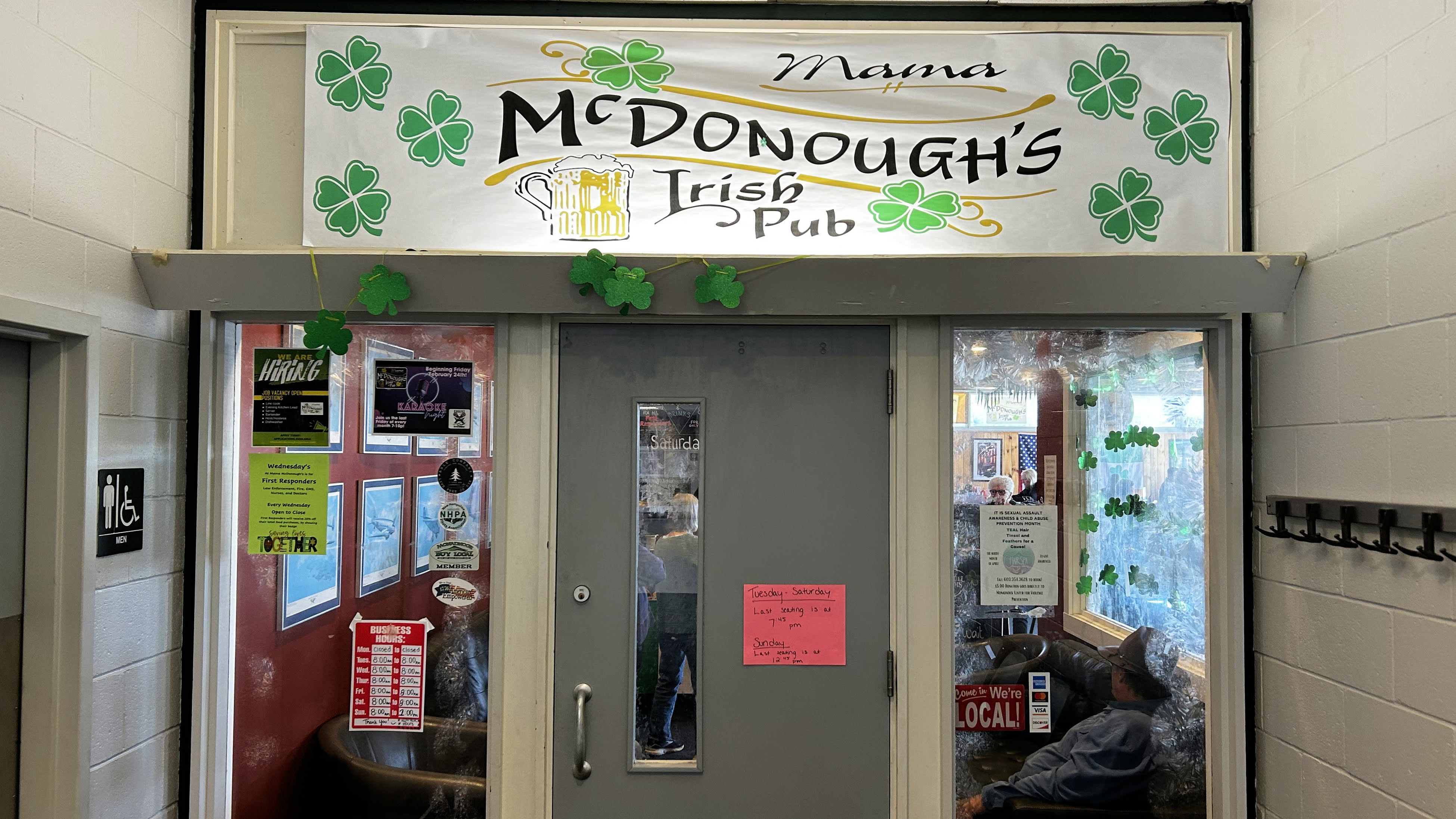
Mama McDonough's occupies the eastern end of the terminal building that is shared with the local FBO, Monadnock Aviation. Beyond the pub's unassuming entrance, a line of patrons were waiting to be seated. It was obviously a popular place.


As I waited, I noticed that the day's special was buy one / get one burgers. Should have brought a friend. Regardless, I was at an Irish pub and that usually inspires me to order fish and chips.

Two waitresses worked the room. While busy, they were friendly and efficient. From my seat, I had an excellent view of the ramp and the comings and going of piston and turbine aircraft alike. Partway through lunch, a large turbine aircraft taxied onto the ramp and swung its rear end around to point at the little airplane tied down at the opposite end of the row of parked aircraft that included Warrior 481. Caught in jet blast, the small two seater danced and swayed to the extent that its tie down ropes permitted. It was a demonstration of poor manners from the jet crew and I was grateful that it was not my airplane on the receiving end of the jet wash.

My fish and chips were delicious; my Scottish grandmother would have been pleased. When I cut into the lightly breaded deep fried haddock, I found the fish inside to be perfectly cooked and remarkably moist. Onion rings included among the chips were a nice touch. Excellent food, great service, and a view of the airport ramp made for a terrific lunch experience.


When I returned to the ramp, the piston aircraft had completely turned over since my arrival. Not bad business for an airport diner on a Tuesday.

Taxi Slog

The north ramp at Keene was quite a bit more "turbiney" than most uncontrolled airports I visit.

Though I saw no notifications of this in official FAA sources, a sign near the terminal proclaimed runway 2 as the preferred calm wind runway. In resignation, I made the long taxi from the north ramp back to the departure end of runway 2. I have taxied shorter distances at much larger commercial international airports. 

Drafty

Warrior 481's power plant ran up normally and I departed Keene satisfied with another successful visit to a new airport. Climbing northbound off runway 2 with the town of Keene directly below, I turned westbound as soon as I judged myself well positioned to outclimb the foothills of the mountains immediately west of the airport.

It was unusually breezy in the cockpit, but I focused on flying the airplane until I turned on course and pitched the nose down a few degrees to enter a cruise climb. My troubleshooting was brief. The top latch on the door had come undone. My last experience with this was in a rental Cherokee 180 (N3470R) back in Michigan. Reduced static pressure in the slipstream pulled the door outward just enough that I could not engage the latch. I had two options. I could return to Keene and latch it on the ground or I could wait until I leveled off and put the airplane into a slip (fly it slightly sideways) to push the door closed so that I could latch it in flight. I have never tried the latter and had no practical experience with the technique, only that it should work in principle.

Amusingly, I told the story about Seven Zero Romeo's top latch popping open with Kristy on board recently over dinner with friends. I had bragged to that audience that Warrior 481's door has never popped open in flight during twenty years of ownership. While I guess that boast is still true, I had to eat a little crow with Kristy when I returned home and told her about the incident at Keene.

Crossing through 2,500 feet with the foothills now passing beneath my wings, I was considering my options for dealing with the door when the entire airplane began shuddering as though trying to tear itself apart. Thoughts of the door were promptly relegated to the back burner.

Shake, Rattle, and Roll

The only time I had ever observed such rough engine operation was the one time I experienced carburetor icing in the Warrior. Without even thinking about it, I turned on the carb heat and waited a moment, but nothing changed. I pushed the nose down to a level flight attitude and pulled the throttle back. The roughness ceased below 1300 rpm. I pulled the throttle to idle, pushed the nose down to maintain airspeed, and rolled the airplane back toward Keene. In the turn, I noticed that the JPI engine monitor showed zero temperature reading on cylinder #1. This meant that it was not generating any power.

That explains the roughness. Four cylinder engines don't like running on just three.

"Keene traffic, Cherokee Four Eight One is two miles west and returning to the airport with a rough engine." 

A Mooney inbound for the pattern immediately yielded the right of way to me. I glided back to the runway without any difficulty and actually had excess altitude that I needed to bleed off with a massive forward slip prior to touching down. 

Foreflight ground track showing the departure and immediate return to Keene.

At taxi power, the engine ran smoothly and I vacated the runway. Once on a taxiway, I tried to run the engine up again, but the airplane shook violently when I advanced the throttle above 1300 rpm. In taxiing from the terminal to the departure end of runway 2 just a few minutes earlier, I noticed Monadnock Aviation's maintenance hangar on the northeast ramp. I shut down there and called Ray. He was concerned that I had a stuck valve, but we decided that I would consult with the on field mechanics to see what they could discover.

Benchmark for Customer Service

I wandered into the tidy shop and met Tim and Warren of Monadnock Aviation who listened to my story. Warren explained that, before they could look at my plane, I needed to work out an arrangement with management back at the main terminal building. I called over there and was eventually connected with Beth, a Rochester Institute of Technology grad who was in charge. At her prompting, I described the incident again.

"OK. But first, how are you?" she asked.

"I'm fine." My heart rate wasn't even up.

"Pilots react differently to these situations, so I just want to make sure that you're OK."

"Thanks for asking, but I'm OK." It was thoughtful of her to ask. Once that was out of the way, Beth was all business.

"They're pretty busy right now, but they can probably do some troubleshooting. I cannot guarantee that they will be able to fix whatever is wrong today." 

I understood completely. How could she make any promises without knowing what the problem was? Once she verified my understanding, she asked to talk to one of the guys in the shop. I handed my phone over to Warren so that she could speak with him.

After some additional bureaucratic steps, Tim pulled the Warrior into their hangar. He immediately removed the valve cover on cylinder #1 to check for a stuck valve, but as he turned the prop, the valves moved as expected. It was not a valve problem.

Next, Tim pulled the bottom spark plug out of the affected cylinder. "Well, I found a problem," he declared and handed the spark plug to me.

Broken spark plug.

The ceramic insulator near the electrode was in pieces. When he checked the top spark plug in cylinder #1, it was badly fouled. Despite the redundancy of two spark plugs per cylinder, both plugs in the same cylinder had failed in different ways. What are the odds of that?

Tim replaced the broken spark plug and asked if I wanted him to clean up the other one or replace it as well. I suggested cleaning it first. Tim retreated to the rear of the shop to work on the plug. When he returned, he commented, "It makes a spark now, but it's not a great spark. Keep an eye on it, you might want to replace this one, too."

Tim wrapping up the spark plug replacement on cylinder #1.

With the repair complete, I taxied the Warrior to the edge of the ramp and performed a run-up. The engine ran smoothly regardless of whether I ran on both ignition systems or either individual. Tim printed up a log book sticker for me and sent me back to the main terminal to settle my bill. "They don't let me handle any money," he indicated with a shrug. The total came to $160, not bad for some time and materials. My experience with Monadnock Aviation was the exact opposite from my experience at Columbia County Airport in 2012 when I suffered a carb fire and was presented with a four-figure invoice for essentially no real work. Huge thanks to Tim, Warren, and Beth for their prompt, professional assistance. As a friend of mine later summarized about the entire incident, "It was the best worst thing that could have happened."

After paying my bill, I was taxiing back to runway 2 when another aircraft on frequency called me. "Hey, Four Eight One, what happened to your engine?" I explained the dual spark plug failure and thanked the unknown pilot on the other end of the radio for his concern.

Aftermath

Warrior 481 underwent another successful run-up as I worked through my departure check list. Not forgetting the contemporaneous door issue, I double checked the door latch before throttling up to take the runway.

The engine ran well. The cabin remained free of drafts. I climbed back over foothills of the mountains and ultimately to 6,500 feet for the ride home.

JPI EDM-700 display showing high EGT on cylinder #1.

While the engine ran palpably well, the engine monitor still indicated an issue in cylinder #1. Normally, my exhaust gas temperatures (EGTs) run close to the same value. But EGT on cylinder #1 was running hotter than the others by 170-200 degrees. High EGT usually indicates an inefficient burning of the air/fuel mixture causing a delay in combustion that means less energy is used on the power stroke and more energy is lost through the exhaust valve. EGTs increase during magneto checks for the same reason with each cylinder performing less efficiently on a single spark plug than it normally does on both. Cylinder head temperature (CHT) on #1 was commensurately low.

Tim's comment about the cleaned spark plug not yielding a great spark came back to me. I had that spark plug replaced the next day and in subsequent flights, EGT on #1 has been in line with the others.

So, What Happened?

I am puzzled by the fouled plug. I am very rigorous about leaning my engine, even during taxi, to avoid loading up the plugs with carbon. Did I do so during the long slow taxi from the terminal ramp to the departure end of runway 2 at Keene that day? I could not recall. When I expressed my surprise about the fouling to Tim, he concurred. "Beyond that plug, it looks really clean in there," he noted.

As for the broken spark plug, I only know of two possible root causes for that. Either plugs get dropped / damaged during maintenance and fail later in flight or they experience a detonation event.  Given the successful engine run-up and initial smooth climb away from Keene, it is obvious that the plug failed in flight. I am reasonably certain that no detonation occurred while operating with a full rich mixture in the climb. In real time, I saw no evidence of the whopping temperature spike that would have accompanied detonation and the JPI did not squawk any temperature alerts as it is programmed to do. (And has previously). The most impartial arbiter of what really happened before that cylinder went cold would be temperature data logged by the JPI engine monitor. After multiple download attempts and a consultation with JP Instruments, it appears that the device stopped logging data at some point. I am in the process of working through a fix with JP Instruments, but frustratingly, those data from Keene are lost forever.

Regardless, I put 4.5 hours in local flying on the engine prior to my next trip and observed completely normal operation that provided confidence for the next adventure. In the end, even though it was "buy one / get one burger day" at Mama McDonough's, I am glad that I did not bring a friend with me on the flight to Keene. Sometimes, we get a little more adventure than we need.

Monday, March 11, 2024

The Fateful Call

Twenty years ago today, I bought an airplane. 

The first picture I ever captured of N21481, taken at Three Rivers, Dr. Haines Municipal Airport (KHAI) on 13 March 2004, the day after I flew her home from Guthrie, OK.

My first official act as an aircraft owner was cold calling Dad. "Hi Dad! I'm in Oklahoma and I just bought an airplane." It was a cocky way to blindside him with new information, but I had just conquered Maslow's Hierarchy of Needs as an early 30-something and needed to crow about it. After all, I was now the proud master of a "private aircraft", a beautiful, gleaming, (twenty-six year old) Piper Warrior II, a PA-28-161. (Or, to decode Piper's designation, Piper Aircraft design #28, 160 horsepower, semi-tapered wing.) Compared to the tired, 100 horsepower, 2-seat Cessna I did my training in, this airplane was a veritable beast and it had a great paintjob, too.

Less ostentatious, my first experience as a new aircraft owner was immersion into the glamorous world of rural airport courtesy cars. While Westchester County Airport in metropolitan New York has fancy Mercedes loaner cars, that is definitely not the case out in the sticks. In Guthrie, OK, I was privileged to helm the world's shakiest Ford Taurus from the airport to the local Best Western. "Don't drive it any farther than you want to walk," advised FBO owner Glen Crabtree. He was not kidding. Maintaining that wobbly sedan along a true course was a recipe for repetitive stress injury. But in the end, it served the need, the price was right, and I was grateful that I did not need to hoof it between airport and hotel.

Did you know that Guthrie was the original state capital of Oklahoma? Every local I encountered  boasted of that glorious sliver of time from 1907 to 1910, though little was mentioned about anything of note happening since. Guthrie's replacement as capital by Oklahoma City in a 1910 vote was surely a boon to elementary students everywhere facing that dreaded state capitals quiz.

My favorite new airplane accessory was a warped mutant of a tow bar, slightly bent with opposite ends twisted out of coplanarity and the prongs reattached by welds resembling the inflamed finger joints of an arthritic. It was a veteran tow bar. A survivor. (Barely.) Prior owner Bill was reticent to admit owning that deviant thing, but it served its purpose for ground handling during stops on the long flight home. After my first solo Warrior landing in Bolivar, MO (M17), I used it to pull the Warrior toward the fuel pump and nearly ran the left wingtip into a chain link fence. It was evidence that high wing pilots who buy low wing airplanes need to process their surroundings in a different way.

"Don't tell anyone I gave you that tow bar!" Bill admonished out of embarrassment. Where I was going, no one had ever heard of him and his secret shame was safe. Until now, I suppose. Surely we are beyond the statute of limitations for embarrassing tow bars. I bought a new one sometime in 2004, but kept Bill's as a trophy of sorts.

N21481's primitive instrument panel with a "high tech" handheld GPS velcroed to the yoke, 01 July 2004. Five of the instruments in this photo are now desk ornaments, but I still have that headset.

When I received the keys from Bill, they were accompanied by a tarnished brass disk embossed with "21481" and a hole punched through it for attachment to a keyring. It obviously predated Bill's ownership of the airplane and I wondered if it was a carryover from the Warrior's time on a flight line when keys to the entire training fleet would have hung together on a pegboard. Decades later, that round tag is still on my keyring.

Year one of ownership was enriched with an abundance of "learning opportunities". These began with the first time I engaged the Warrior's starter as owner. A rapidly diminishing groan came from the Warrior’s snout and the prop lurched through a half-hearted partial arc before stopping. The lessons? Too long with the master switch left on during a pre-purchase inspection can really kill a battery. Also, weak batteries cannot start airplanes. Quinn from Crabtree Aviation helped me jump start the plane, which I ran for a time to restore some oomph to the battery before shutting down at Guthrie's fuel pump. I had never personally fueled an airplane previously because the pumps in Three Rivers, MI (KHAI) were full serve only. It was a morning of many firsts. 

When I was ready to make my escape from balmy Guthrie for much colder Three Rivers, I was relieved that the starter turned the engine over without struggling. With March being one of those "you never know what you're going to get" months in the wintry north, I found myself creeping forward, state to state, VFR only, and hypervigilant of weather conditions. These were days before the proliferation of AWOS/ASOS stations and the advent of ADS-B (FIS-B) weather displayed on a tablet in the cockpit. (A tablet? What's that?) It was only my second time using GPS in an airplane, with credit to Kristy for realizing that it would be a useful cross country navigation tool before the thought occurred to me. That aerial journey home was six times longer than my longest flight to date and was made at the controls of an airplane in which I only had an hour in type. Given my minimal experience at the time, I am not sure if this made me intrepid or stupid beyond the actual fact of a successful outcome.

07 April 2004: Kristy got her first ride in our airplane. Photo by Arjo from Dave's Decathlon.

Knowing how to jump start the plane was a valuable skill, especially the first time Kristy and I flew to Dalton Airport (3DA) in Flushing, MI to visit my in-laws. Giddy to show off my beautiful airplane, I skimmed too quickly through the shut down checklist and left the master switch on over lunch. This reinforced the lesson about weak batteries being unable to start airplanes, but now I was well versed in jump starting the Warrior. Because of this incident, Penny suggested naming the plane "Charger", but the 1970s Chrysler OEM alternator in the plane was as close as I wanted to associate with the Dodge brand. (Appropriately enough, I later learned that the alternator was definitely a bit "dodgy".)

Warrior 481 at Dalton Airport with Terry about to get his first flight, 24 April 2004, photo by Kristy?

Leaving the master switch on is one of those actions accompanied by such mortifying embarrassment that it only happens once. Another comparable example from the "lack of attention to detail" bucket is starting an airplane and attempting to taxi out of a parking spot while still chocked, something that I have also done exactly once. Because it happened on a crowded ramp in front of a popular fly-in restaurant in St Mary's, PA (KOYM), I was guaranteed long lasting shame as a memory aid. Once is enough.

Kristy with Warrior 481 before embarking on our grand adventure to Florida in 2005.

On another flight to Dalton, we (i.e., Kristy) learned empirically that opening a tube of hand lotion at 5,500 feet can result in rapid self-dispensing. Because good science requires reproducibility, we (i.e., Kristy) demonstrated the same phenomenon in 2017 over the Smoky Mountains with a dip tube style water bottle. At least water eventually evaporates. Hand lotion is a messier problem.

Parked in front of my first hangar in South Haven, 05 April 2004. Nose strut inflation is a little low.

When I first brought the airplane home to her new hangar at the South Haven Area Regional Airport (0D1/KLWA), I was immediately faced with a geometric challenge. I needed to push an airplane with a 35 foot wingspan through an opening that was 40 feet wide. While the numbers certainly indicate that the goal was achievable, perspective can be a funny thing and those wingtips seemed awfully close to the sides of the hangar as I anxiously pushed the airplane inside with Bill's misshapen tow bar. 

Out darn (oil) spot! Soiled hangar floor visible at the South Haven Airport, 25 September 2004.

During that first year of ownership, my mentor Dave encouraged me to take control of my own maintenance and worked with me to accomplish my first oil change. Unlike the Lycoming O-360 in his Super Decathlon, the Warrior's oil pan did not possess a quick drain valve on the right side. These valves allow for clean and easy voiding of used oil from the engine through a hose and into a container. With my airplane apparently lacking such a convenience, we rigged a funnel in the mouth of a jug to catch the oil after removing a plug from the oil pan. This resulted in permanent recoloration of the hangar's concrete floor because the oil pan drained more quickly than the funnel, which overflowed almost immediately. In this case, the funnel was what we chemists call the "rate limiting step". 

To add further insult, while cleaning up the resulting mess, I noticed that there was a quick drain valve installed on the left side of my oil pan. Oil change padawan that I was, I revealed this to my chagrined Jedi Master and we both learned something useful about making assumptions across engine models. Despite crunching over kitty litter on the hangar floor for the next couple of weeks, a discernable localized stain persists to this day. At least all future oil changes went smoothly via the newly discovered quick drain.

When you have friends trained in the art of formation flying, they always want to practice. Whenever our airplanes were in the air together, Dave was always parked off my wing. 22 August 2004.

Another aerial incident emphasized the importance of an instrument scan that goes beyond the basic six pack of primary flight instruments. While flying southbound over the Lake Michigan shoreline with Dave in his Decathlon flying in close formation off my starboard wing, I lost transmitter capability. This was quickly followed by horrific screeching on the intercom and eventual loss of radio reception. Confused and annoyed, I returned to base at South Haven. While grumpily snapping off switches during the shut down flow, I reached for the avionics master switch and noticed for the first time that the ship's ammeter was pegged at zero. This meant that the alternator was no longer providing any current to the electrical system and that everything was powered on borrowed time until the battery gave up. Alternator failure was the natural outcome of my 1970s Chrysler alternator breaking loose from its mounting on the front of the engine and shaking around until its internal components disintegrated. (See? I said it was dodgy.) These kinds of events change a pilot's behavior. How many pilots grab the housing of their alternator to give it a good shake on every preflight? I've been doing that consistently for 20 years as a result of the Alternator Incident. Additionally, though it may be inconveniently placed on the lower right portion of the instrument panel, that ammeter remains in my scan all these years later.

Cell phone photo by Ross W from Dave's Decathlon in formation with Mark in 33P and me in Warrior 481 over South Haven, MI, 30 July 2005. Fun fact: Ross' grandfather Irving had been in aviation for so long that his 1926 pilot certificate was signed by Orville Wright. This photo was taken just nine days after Dave and I were laid off from "UberCo" along with 500 other scientists.

When I first took possession of Warrior 481, it quickly became obvious that my landing skills needed refinement. According to the official Cherokee Warrior II Information Manual, the recommended approach speed with full flaps is 63 knots. However, on the flight home from Guthrie, I made my approach at exactly 63 knots to the Kentland Municipal Airport (50I) in the midst of a windswept Indiana cornfield. When the wheels made contact, the airplane gently went airborne again before settling a second time. It was less of a bounce and more of a skip. "I liked your landing," said the old timer working the airport while grinning toothily. "Both of 'em!" When I reflect on meeting the fellow 20 years ago, all I remember is white hair and teeth.

To my frustration, this kept happening, but only when I was flying solo. Realizing that 63 knots was intended for the airplane at its maximum gross weight, I started backing off on my landing speed when lightly loaded. Eventually, I settled for a fence crossing airspeed of 55 knots when solo, 60 knots when carrying one passenger, and 63 knots when loaded near maximum gross. Given the Warrior's propensity to float at higher approach speeds, these adjustments made my landings softer, shorter, smoother, and more consistent. This was affirmed by a total stranger one day at the Mason County Airport (KLDM) in Ludington, MI. Right after I touched down, a pilot waiting to depart was so moved by the grace of my refined landing technique that he offered this unsolicited commentary on the radio: "That was a really nice short landing for a Warrior!" It wasn't just the rando in Ludington who validated my technique, it has also withstood the scrutiny of many flight instructors over the years.

17 September 2003: riding back seat with Dave and looking down South Haven's grass runway 14.

With normal landings figured out, the next challenge was landing on South Haven's turf runway 32 that was normally favored by the wind off Lake Michigan. Although 3,260 feet is plenty of length to land a Cherokee, this was complicated by high trees on the approach end and an undesirably gopher infested surface for the latter half of the runway. Flying a steep approach while cranked around sideways in a full forward slip became the norm to get down and stopped before the runway midpoint. Just above the ground, all three axes of flight needed to be fixed before touchdown: wings leveled, rudder used to align the airplane with the runway, and a gentle pull on the elevator to ensure settling the airplane on its main gear. During one instance, we were hosting a cookout at Dave's hangar. I performed this landing maneuver in front of a large audience of other pilots while making all three attitude corrections in one fluid motion and settling to the grass light as a feather. It was pure poetry; all these years later I still remember exactly how that landing felt. Taxiing off the runway to run a gauntlet of witnesses, I was appalled to see Mark hold up a big sign with the number "6" on it. Once he knew that I'd seen it, he laughed and inverted the sign to read "9", then dropped the sign altogether and picked up another that read "10". Behind him, the others held up both hands with all fingers splayed, a perfect 10 from every judge and a welcome confidence boost for a newbie aviator.

The Bear on the controls for the first time. 1 September 2012.

Obviously, more learnings were to come. Increasingly longer cross country flights and the need to manage weather. Achievement of an instrument rating and the need to manage weather in a completely different way. Flying with first an infant, then a toddler ("Me fly in the Daddy airplane?"), and eventually a precocious youngster to whom I regrettably described the function of the Course Deviation Indicator ("Daddy, you're off course again.").

In Cortland, NY, 08 September 2014.

A house is a house and a car is a car, but buying an airplane in 2004 literally changed the course of my life. One new engine and several avionics upgrades later, she is still going strong. I have logged 2571.8 hours at her controls, we have visited 263 airports in 29 states and provinces together, and travelled a total distance of approximately 340,000 statue miles. I have seen many beautiful vistas, enjoyed wonderful adventures, happily shared the experience with others, stayed connected with far flung friends and family, and learned much along the way. It is often said that the cockpit is a poor classroom. While I agree with the sentiment underpinning this, airplanes and aviation are nonetheless excellent teachers.

Stagnation was the main motivation for venturing down the ownership pathway. By the end of 2003, I ran out of worthwhile adventures in the rental aircraft available to me in Three Rivers, MI. I was getting bored and I needed something new to do or else I would have stopped flying altogether. With Dave as a role model and concrete example that it was possible, I bought an airplane 20 years ago and never looked back. 

I guess the strategy worked, because here we are.

Sunday, February 6, 2022

Adventitious Icing on Alton Bay

Anticipation
(Cue Carly Simon)

February 2022: 

For the Northeast aviation community, the opening of New Hampshire's novel Alton Bay Ice Runway (B18) on the frozen surface of Lake Winnipesaukee is an eagerly anticipated annual event. Last week, the team in Alton Bay announced that the ice was finally thick enough (12"+) and that, pending weather and an inspection by the New Hampshire DOT, the runway might be open for the weekend. Several Williamson Flying Club members were eager to log their first landing on the ice. For my part, I had promised The Bear a trip to the uniquely frigid FAA-sanctioned airport and was looking forward to a father-daughter excursion.

Naysayer that I am, I was certain that the storm that dumped heavy snow on Rochester Thursday and Friday before moving eastward into New England would complicate efforts to plow and perform the DOT inspection of the ice in time for a weekend opening. There was no way it would happen for Saturday and even Sunday seemed like a stretch. But the weather throughout the region was promising and hopes were running high. Nevertheless, as of Sunday morning, the airport was still NOTAMed closed.

I pitched an alternative Sunday destination: Westfield-Barnes Regional Airport in Westfield, Massachusetts (KBAF). Westfield is home to Tobiko Sushi, considered by our small band of culinarily-inclined aviators as purveyors of truly excellent sushi. Dan (in 1DT) and Tom & Alicia (in 26R) were in. Gilead (in 85X) chose to explore Martha's Vineyard instead. 

Buckle Up

DateAircraftRoute of FlightTime (hrs)Total (hrs)
06 Feb 2022N21481SDC (Sodus, NY) - BAF (Westfield, MA) 1.82414.2

KSDC photographed 05 Feb 2022.

KSDC photographed 05 Feb 2022.

Most of us at the Williamson Sodus Airport have spent more time digging out of our hangars than actually flying lately. But Warrior 481's preheated engine turned over immediately and we navigated the slick airport surfaces with thoughtful awareness of wing position versus the mountains of snow towering above our aircraft.


Watch that wingtip!

At the departure end of runway 10 with Dan and Tom waiting for their turns.

A moody wind gusted directly across the runway, fickle in direction and occasionally belligerent in strength. Taking a lesson from a departure last week when wind gusts bounced me out of my seat despite a fastened seatbelt, I took a moment to pull the belt extra snug. A movable airplane yoke is a largely useless thing to cling to for dear life and I did not want to repeat that earlier experience. As expected, there was some intense rocking and rolling for the first few hundred feet of the climb, but this time, I stayed glued to my seat.

"Tighten those seatbelts," I advised on UNICOM. 

Departing in 1DT a few minutes later, Dan broadcast his own supportive advisory on the radio. "Chris wasn't kidding!"

Our three airplanes fell in line at 7,500 feet with mine in the lead. When I radioed Syracuse Approach for flight following, I advised that there were two other Cherokees behind me for the same destination. Having observed our aerial convoy on his radar display, the controller indicated that he was already putting everyone into the system and just waiting for them to call in. There is nothing better than a controller on top of his game who actively anticipates the needs of his customers. The brief episode would later contrast sharply with the manner of service we received while departing Westfield-Barnes that afternoon.

Snow White


Deep snow everywhere nearly masked the city of Syracuse as we passed 1.5 miles above the bleached terrain.

Otsego Lake near Cooperstown, NY.

Cooperstown Dream Park.


The inevitable question came within moments of being switched from Syracuse to Albany Approach.

"Cherokee Four Eight One, I have a question if you have a moment. I see there are two other aircraft inbound to Barnes behind you. What's going on over there today?"

We have been asked variations on this question so many times when traveling as a pack that, while still amusing, it no longer comes as any kind of surprise.

"Just three of us headed for lunch," I responded. Considering how often this question is asked, I need a more clever response.

The Catskill Mountains.

Castleton-on-Hudson and Alfred H Smith Memorial Bridges over the Hudson River.
.

It looked to me like the Hudson River was in need of some Lipitor.

The King Is Dead...Long Live the King

Despite all the whiz-bang tech I put into the panel since buying Warrior 481, I have continued to use a 50 year old King KX-170B radio as my #2 navcom. I usually task it with monitoring Guard, listening to ATIS/AWOS/ASOS reports, or speaking with Ground. Over the past year, that radio became increasingly frustrating to use due to random squelch breaks that would fill my headset with static. There was also the 2021 Ocala Incident where I missed some calls from Ocala Ground while using that radio. A couple of weeks ago, frustration exceeded inertia and I decided to do something about it. But what?


While the new Garmin GNC 255 radios are nice, they're also $5,000 just for the box without installation. I struggled with the notion of spending that much money to essentially maintain existing capability. Jake at Boshart Enterprises hooked me up with Bennett Avionics in Connecticut, who took my old KX-170B on trade and sold me a "1970 showroom new" (my words) refurbished unit for just a few hundred dollars. The new antique looks and sounds great and I definitely enjoyed the lack of random static during the flight to Massachusetts. (There was no static or meowing on Guard for me to listen to!) With excellent cosmetics, the new King radio looks less like it went through combat than its predecessor.


Notorious Nigiri

To my surprise, Bradley Approach informed me to "contact Tower" without providing the frequency. The same happened to Tom. It was not a problem, I already had the frequency dialed into standby, but it was definitely unusual. I wondered if Bradley Approach mistook us for locals.


I was cleared to land on the 9,000 foot long runway 2 at Westfield-Barnes, which I did while visually verifying that the military aircraft arresting barriers were properly retracted into the pavement. The admonishment in the Chart Supplement that they periodically fail in the "up" position could ruin the day of any pilot not paying attention, potentially resulting in a "gear up" (gear off?) landing for a fixed gear aircraft like mine.


My parking OCD got the best of me and I made several adjustments to the Warrior's position with the tow bar before deciding that it was satisfactorily centered over the spot. I imagined the tower controller watching me with amusement.


Tom and Alicia arrived next, having passed Dan flying the slower 1DT. But Dan holds no ill will. When he finishes his RV-8A, he will be passing all of us. Sweet vengeance will be his.


Once Dan arrived in 1DT, it was time to eat!

WFC aircraft at Westfield-Barnes.


Tobiko Sushi shares the terminal building with the FBO, Rectrix. (Or is it Ross Aviation? Both names appeared to be in use.) We arrived shortly after opening and had our pick of tables, but the place filled up as we ate. It was obviously a popular destination.


I was sorely tempted by the specialty rolls, especially the various combinations containing tempura shrimp, crab, and avocado. But I decided to keep it simple and ordered a traditional sushi platter instead. It was yummy and Alicia was kind enough to share some of her fried shumai (shrimp) dumplings. As before, everyone's meals were excellent.

Never Say Never

As we finished lunch, I opened ForeFlight on a whim and checked NOTAMs for Alton Bay. From our location in Westfield, Alton Bay was just under an hour to the northeast. To my utter surprise, the NOTAM closing the airport had been rescinded. Tom called the Alton Bay information number (603-271-7398) and learned that the runway opened at 12:07 while we were eating lunch. Within seconds of this discovery, I received a text from Gilead: "Alton Bay is open." Even though tone is hard to glean from text messages, the excitement in his message was obvious.

It was a short discussion. Of course we were going to the ice runway, whether we deliberately planned to or not. It would be a first time for Tom, Alicia, Dan, and Gilead. The Bear was going to be angry, but visiting the most ephemeral airport in the United States requires opportunistic action. Our only concern was the wind. Since Alton Bay became a one way airport in 2020, with landings only allowed to the north (runway 1), the increasing southerly wind could close the airport before we arrived. It was a chance that we were willing to take.


Outside, I paused to study one of the two brand new 2021 Piper Pilot 100i aircraft owned by Westfield's Fly Lugu Flight Training. These stripped down Archers feature advanced instrument panels, seating for three (rather than four), and comparatively hefty price tags from the factory. Fly Lugu rents theirs wet at $185 per hour. I wondered if this was truly a good value for training rather than retrofitting an older airframe with the same avionics. (Warrior 481 and Tom's 26R stand as good examples of that.)


Despite the large investment made in new Pipers, they were relegated to outdoor parking and this one had an incredibly contaminated wing. It would not be going anywhere anytime soon.

Pillar of Pedantry

Date Aircraft Route of Flight Time (hrs) Total (hrs)
06 Feb 2022 N21481 BAF (Westfield, MA) - B18 (Alton Bay, NH) - LCI (Laconia, NH) - SDC (Sodus, NY) 4.4 2418.6

Getting flight following from a towered Delta field can be hit or miss, but the Westfield-Barnes ATIS explicitly instructed pilots wishing flight following to inform ground of the destination and desired altitude. Awesome.

"Westfield ground, Cherokee Two One Four Eight One, at Rectrix, VFR to Bravo eighteen at five thousand five hundred, Mike."

"Cherokee Four Eight One, are you requesting flight following?"

"Affirmative, Four Eight One," I responded brightly.

"Shoulda been the first words out of your mouth." I was taken aback. That seemed unnecessary. I had been making that standard radio call for years at various towered airports and no one had ever been confused before. But I forged ahead, receiving my departure information and taxi clearance.

As I taxied for an intersection departure on runway 20 at taxiway Alpha, I heard the controller run roughshod over Tom as well, nitpicking his radio phraseology. Even though the controller knew what everyone wanted, he played dumb until requests were phrased exactly the way he wanted to hear them. Pedantry for its own sake is rarely an appealing quality. Then the finicky controller proceeded to give contradictory instructions to a pair of aircraft in the traffic pattern.

Westfield-Barnes Regional Airport seen on departure.

Before long, I was airborne, turned directly on course, and switched to Bradley Approach for flight following while Tom and Dan departed behind me. Fortunately, Dan managed to escape Westfield without rebuke, but after listening to our interactions with the controller, decided against making a flight following request.

The Connecticut River northeast of Westfield.


"Cherokee Four Eight One, you have a target at your six o' clock, three miles, same altitude and direction," cautioned Boston Approach. It was Tom. While I knew that he was there, I lacked a rear window and had no way of monitoring him visually. He was not on with Boston and I hoped that he had me in sight.

"Eight Five X-Ray, altitude your discretion," I heard Boston call to Gilead. I searched the traffic display and quickly found the WFC's flagship Archer tracking northward from Martha's Vineyard. He would arrive right behind us as though executing on a precise plan for an ice runway rendezvous.

A Bonanza checked in from a few miles southeast of Laconia. "Bonanza Three Bravo Lima, are you coming from Alton Bay?" queried Boston Approach. The Bonanza pilot was quick to boast that he had been the fourth airplane to land after the runway opened. Cool beans.

Icy Brigadoon

There's a runway hidden amidst all that white.

I navigated through a notch in the terrain immediately west of Alton Bay to enter downwind for runway 1. The poor contrast of white on white made for a nearly invisible runway until I entered the pattern, but I knew the lay of the land well enough to intuit where it was. The wind was picking up out of the south and caused me to land longer than I would have preferred, but the field remained open despite the elevated wind and I had no problem stopping before the end of the 2800 foot runway. From the parallel taxiway, I watched Tom settle his airplane to the ice like a pro.


As in past years, volunteers managed the choke point where the approach end of runway 1, the parallel taxiway, and the parking area all intersect.

Tom and Alicia arrive at Alton Bay.

As we pushed Tom's airplane back into parking, he went for his tow bar to square it up versus the edge of the parking area to avoid "triggering my parking OCD". 

"No need for that," said one of the volunteers who proceeded to straighten the plane simply by twisting it on the ice.


As in 2019, all arriving pilots were given an Alton Bay poker chip as a token recognizing their accomplishment. 

No monetary value.

After welcoming Tom and Alicia to the ice, I discovered that I was missing my gloves and ultimately realized that I left them at Tobiko Sushi. Who has two really cold thumbs and lands on ice without gloves? This guy. I usually bring boots and YakTrax to Alton Bay, but did not have them with me on account of my certainty that the runway would not open that weekend.


A few minutes later, Dan achieved his first landing on the storied ice runway as the rest of us watched. It looked good from where I was standing.

Congrats to Dan on his first landing at the Alton Bay Ice Runway!


Gilead appeared overhead in 85X a few minutes later, did not like the look of his approach, aborted, and went around the pattern to try again. It was an excellent choice and the second time around was just right.

Gilead being marshalled to parking in 85X.

Gilead arrived with his friend Teddy riding right seat.

Dan looks really happy to be at Alton Bay!

Gilead with 85X.

Group photo by Teddy: Dan, Gilead, me, Alicia, and Tom.

And that is how four aircraft from the Williamson Sodus Airport and three first time ice runway pilots unexpectedly found themselves at Alton Bay on opening day.


Traffic at Alton Bay was relatively quiet, but we got to see some interesting aircraft like this Icon A5 light sport amphibian. Probably not a very practical ride, but it looked like a lot of fun.

A nice looking Cessna 140 on the ice.


I met the pilot of this Husky, Greg, on Facebook after the fact. He memorably arrived with his dogs.


Cessna 185s have a reputation for being squirrely. I wonder how this one performed on the ice?


I had a moment to chat with Paul LaRochelle, long time volunteer manager of the ice runway who retired from the role this year and is supporting the new manager (Jason Levitt) during the transition. I expressed surprise that they were able to plow the runway and get their NH-DOT inspection done on a weekend. Paul grinned and pointed to one of the volunteers marshalling aircraft to parking, "He did the inspection Saturday afternoon." Because, of course, some of the volunteers worked for the DOT.

I shared with him how the Bonanza pilot bragged to Boston Approach about being fourth to land that day. Paul laughed and explained that the first aircraft to land that day was based in nearby Laconia and just happened to be passing by when Alton Bay's opening was announced on UNICOM. Right place, right time.


I was especially amused by the number of random people at Alton Bay getting their pictures taken with Warrior 481.


I have no idea how many people went home with pictures of themselves with my airplane, but it was quite a few. I also saw all of our aircraft in footage from Boston news coverage of the runway opening.

Finally, a moment's peace.


I later learned that ours were four of 29 total airplanes (plus one helicopter) to land at Alton Bay on opening day. It was certainly a much calmer experience than our 2019 Winter Carnival excursion when we were one of 150 aircraft to land on the ice that day.


I suppose that the novel milestone for me was being at Alton Bay with three airplanes that I have previously flown: 481, 1DT, and 85X.


Realizing that daylight was limited, we boarded our ships and went our separate ways. Tom and Dan flew directly back to Sodus with me about thirty minutes behind them after detouring to Laconia for fuel. Gilead and Teddy sought food at Sibley's because there had been no room for them in the diner at Martha's Vineyard. Gilead then flew 85X south to Nashua to drop off Teddy before heading west to Sodus and arriving 1.5 hours after I landed.

Tom launches from the ice runway in 26R.

It is always a joy to visit Alton Bay and I am sincerely grateful to Paul, Jason, and all the other volunteers who came together to make this a uniquely fun and safe destination for pilots in the Northeast.

Two Ice Runways in One Day

Warrior 481's performance was visibly reduced with the downwind takeoff from Alton Bay. But the departure corridor simply extended out over Lake Winnipesaukee and there was nothing to hit in the climb.


Lake Winnipesaukee.


Stopping in Laconia for fuel after departing Alton Bay has become a habit. I could have stopped elsewhere en route, but topping-off in Laconia simplified the fuel planning and avoided landing at unfamiliar airports at night.

Left base for runway 8 at Laconia with the runway barely visible.

The paved runway at Laconia was almost as icy as the one I had just left. After landing, I taxied to the northern reaches of the airport to Emerson Aviation for fuel.


Warrior 481 after taking on fuel at Emerson Aviation.


Laconia Airport

Mini Mountain Majesty

As the sun wrapped up its daily trek, the return flight was made against a 30 knot headwind. Although I hand-flew most of the day up to that point, I switched on HAL after departing the pattern at Laconia, set an aggressive power setting, and let my airplane carry me home while I gawked at the magnificent scenery beyond my windows. What a beautiful cruise it was! 


As the sun crept lower while I traversed Vermont, the warm hues of golden hour reflected from the snow-encrusted Not-So-Green Mountains and restored the landscape to the rusty tones of late autumn.


Golden Hour and Nightfall


There is a magic moment at sunset when the amber globe of the sun reaches an angle that transforms it into a crimson fireball that inflames the clouds from below.


Flying westward in Warrior 481, I witnessed that moment and it was breathtaking. One final gift granted at the end of an eventful day.


Like a switch was thrown, the sun retreated far enough beyond the horizon that the sky was suddenly drained of color; same clouds, but a very different aspect.

I flew the last hour home in darkness with just a dim red glow remaining along the horizon like the faintest trickle of current through an atmospheric filament that eventually faded to darkness.

Notus Awakened

To my surprise, the wind velocity did not relent significantly in the descent toward the Williamson Sodus Airport, but merely shifted to a southerly direction. The lights of Sodus Point slid sideways in my windscreen, hinting at significant wind drift. On downwind, a crab of nearly thirty degrees was required to track parallel to the runway. Despite severe buffeting at treetop level, I slipped the Warrior in for a successful landing on the upwind wheel with a significant amount of aileron fed in. I am grateful to Tom for sticking around to help push Warrior 481 back into the hangar from the icy ramp.

As expected, I returned home to an angry Bear that evening. It seems that I will be looking for another window of opportunity for Alton Bay in 2022. 

I can live with that.

GPS ground track for the complete round robin flight.